
Where is value moving in your industry?
Join leaders, entrepreneurs and investors examining how technological abundance is reshaping competitive advantage.
Receive new essays, company cases, framework developments and selected project updates.
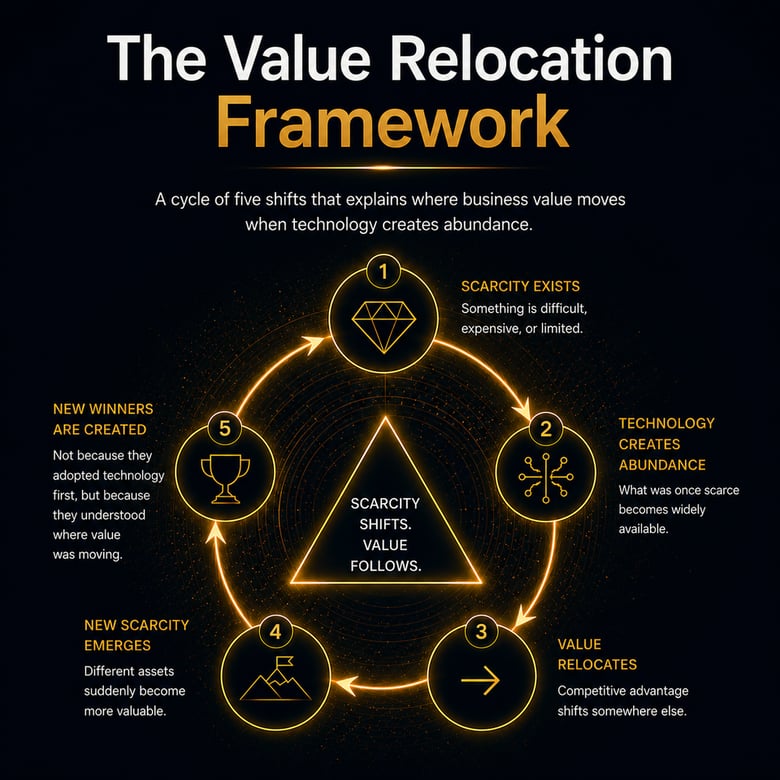
The Value Relocation Framework explains how technological progress changes the sources of economic value.
When a capability that was once scarce becomes widely available, competitive advantage does not simply disappear. It moves toward assets, constraints and capabilities that remain difficult to access, replicate or replace.
Economic value is rarely determined by usefulness alone.
It is shaped by scarcity.
A capability can be highly useful and still lose economic value when it becomes widely available.
Technology repeatedly turns scarce capabilities into abundant infrastructure. What was once expensive, exclusive or difficult to produce becomes faster, cheaper and accessible to many.
As this happens, the competitive advantage attached to the old scarcity begins to erode.
Value then relocates toward the next constraint.
When technology changes what is scarce,
it changes what is valuable.
Value Relocation is the process by which technological progress reduces the scarcity of an established capability, weakens the competitive advantage associated with it and shifts economic value toward assets that remain limited, difficult to replicate or newly important.
Technology makes something abundant.
The old source of advantage becomes less distinctive.
A new scarcity emerges.
Value moves toward it.
Something valuable is difficult, expensive or limited.
Every established source of economic value begins with a constraint. Knowledge may be difficult to acquire. Distribution may be expensive. Production capacity may be limited. Expertise may be concentrated among a small number of people. Because access is restricted, customers, organizations or markets are willing to pay for it.
Which scarcity currently makes your business valuable?
Innovation reduces the constraint.
Technology lowers the cost of producing, accessing or distributing something that was previously scarce. The capability may become faster, cheaper, easier to reproduce or available to a much larger number of people. The technology does not need to eliminate scarcity completely. It only needs to reduce it enough to weaken the existing source of differentiation.
What is technology making dramatically easier in your industry?
The old advantage becomes less valuable on its own.
As more organizations gain access to the same capability, it becomes harder to use that capability as a source of differentiation. Supply increases. Replication becomes easier. Prices come under pressure. Customers begin to treat the capability as an expectation rather than a premium. Value has not disappeared from the system. But it is no longer concentrated in the same place.
Which part of your competitive advantage is becoming a commodity?
A different constraint becomes more important.
Abundance creates new bottlenecks. When one capability becomes widely available, complementary assets often become more valuable. These may include trust, judgment, access, relationships, implementation capability, proprietary data or accountability. New scarcity is not always human, and it is not always permanent. It must be identified empirically in each market.
What becomes more valuable because abundance exists?
Value accrues to those who control the new scarcity.
The winners of a technological transition are not always the organizations that adopt the technology first. They are often the organizations that understand how the technology changes the economic structure of the market. They build, acquire or control the assets that become scarce next.
Which organizations are best positioned to capture the relocated value?
Technology changes abundance.
Abundance changes scarcity.
Scarcity changes value.
Or even more on the point:
Scarcity shifts. Value follows.
Previous scarcity
Physical power and productive capacity
Abundance created
Mechanized production
Value relocated toward
Machines, factories, capital and industrial organization
Previous scarcity
Portable, reliable power and illumination
Abundance created
Distributed energy and continuous production
Value relocated toward
Electrical infrastructure, appliances and new business models
Previous scarcity
Information and distribution access
Abundance created
Global publishing and digital reach
Value relocated toward
Platforms, search, attention, trust and networks
Previous scarcity
Computing infrastructure
Abundance created
On-demand scalable computing
Value relocated toward
Software, data, integration and user experience
Previous scarcity
Analysis, content production, code and structured intelligence
Abundance created
Low-cost access to increasingly capable intelligence
Value may relocate toward
Trust, proprietary context, judgment, execution, access and responsibility
AI does not merely automate work.
It changes the economics of intelligence.
Intelligence has historically been expensive. Organizations paid for years of education, accumulated expertise, analytical capacity and specialized labor.
Generative AI changes the cost and accessibility of many outputs associated with intelligence. Drafting, summarizing, coding, comparing, translating and analyzing can increasingly be performed at speed and scale.
This does not make expertise, judgment or human contribution irrelevant. It changes which part of intelligence remains economically scarce.
AI capability is not the same as competitive advantage.
When everyone has access to similar intelligence, value moves toward what each organization can uniquely combine with it.
Intelligence has historically been expensive.
Organizations paid for years of education, accumulated expertise, analytical capacity and specialized labor.
Generative AI changes the cost and accessibility of many outputs associated with intelligence. Drafting, summarizing, coding, comparing, translating and analyzing can increasingly be performed at speed and scale.
This does not make expertise, judgment or human contribution irrelevant.
It changes which part of intelligence remains economically scarce.
AI capability is not the same as competitive advantage.
When everyone has access to similar intelligence, value moves toward what each organization can uniquely combine with it.
A Scarcity Portfolio is the collection of assets, capabilities and relationships that allow an organization to create and capture value because they are difficult for others to access or reproduce.
Unlike a product portfolio, a Scarcity Portfolio focuses on the economic foundations beneath the products.
Trust
Credibility earned over time and confidence in future behavior.
Judgment
The ability to make sound decisions under ambiguity and uncertainty.
Execution
The ability to turn ideas and decisions into reliable real-world outcomes.
Relationships
Human and institutional connections that create access, loyalty and resilience.
Access
Control over customers, data, capital, infrastructure, networks or opportunities.
Responsibility
The willingness and ability to remain accountable for outcomes and consequences.
Is your organization investing in tomorrow’s scarcity—or defending yesterday’s?
The framework changes the questions leaders ask.
| Conventional AI Question | Value Relocation Question |
|---|---|
| What can AI automate? | What is AI making abundant? |
| Where can we reduce costs? | Where is value moving? |
| Which tools should we adopt? | Which new scarcity should we control? |
| Which tasks will disappear? | Which complementary assets become more valuable? |
| How can we use the same AI as everyone else? | What can we combine with AI that others cannot replicate? |
| How do we protect our existing advantage? | Is our existing advantage based on a disappearing scarcity? |
Operational questions improve the current system.
Value Relocation questions examine whether the system itself is changing.
1. Identify the current scarcity
What do customers pay us for because it is difficult to obtain elsewhere?
2. Detect emerging abundance
Which technologies are lowering the cost, difficulty or exclusivity of that capability?
3. Assess value exposure
Which revenues, margins or market positions depend on the old scarcity remaining intact?
4. Identify the next scarcity
Which assets become more important as the old capability becomes abundant?
5. Reallocate investment
What should we build, acquire, protect or stop doing before the market fully recognizes the shift?
The five areas where it’s all happening
Value Relocation does not claim that every technology produces the same outcome or that value moves in a predictable straight line.
The framework does not assume that human skills automatically become more valuable, that all intelligence becomes commoditized or that technological adoption guarantees success.
It provides a structured way to investigate changing economic conditions.
Research Areas:
1. Industry transformation
How does Value Relocation differ across software, manufacturing, finance, healthcare, media and professional services?2. Competitive advantage
Which scarce assets create durable advantage in markets with abundant intelligence?3. Organizational design
How should organizations allocate decision rights, talent and investment as intelligence becomes cheaper?4. Capital allocation
Which business models gain or lose value as traditional scarcities erode?5. Human and machine complementarity
Which combinations of machine abundance and scarce human or institutional assets create superior outcomes?6. Measurement
How can the strength and durability of a company’s Scarcity Portfolio be assessed?
Explore Company Cases
See how value has relocated across industries and technological transitions.
Assess Your Scarcity Portfolio
Identify which sources of advantage may strengthen or weaken in the age of abundant intelligence.
Apply It With Your Leadership Team
Use the framework in a strategy discussion or executive workshop.
Follow the Research
Receive new cases, essays and developments from the project.
Join leaders, entrepreneurs and investors examining how technological abundance is reshaping competitive advantage.
Receive new essays, company cases, framework developments and selected project updates.