
Where is value moving in your industry?
Join leaders, entrepreneurs and investors examining how technological abundance is reshaping competitive advantage.
Receive new essays, company cases, framework developments and selected project updates.
Artificial intelligence is making knowledge, analysis, content and increasingly sophisticated forms of intelligence abundant. But abundance does not eliminate economic value. It changes where value is created, captured and defended.
The Value Relocation Project exists to understand that shift.
The AI debate is focused on capabilities. Strategy must focus on consequences.
Most discussions about artificial intelligence begin with what the technology can do:
What can be automated?
Which jobs will disappear?
How much productivity can be gained?
These questions matter. But they do not reach the underlying economic transformation. Every major technological shift changes the relationship between scarcity and abundance.
Capabilities that were once expensive, limited or difficult to access become widely available. As this happens, the competitive advantage associated with them begins to erode.
Value does not simply vanish. It relocates toward assets, capabilities and relationships that remain scarce.
The Value Relocation Project was created to study this movement systematically—and to help leaders recognize it before it becomes obvious.
Technology changes what is possible.
Value Relocation explains what becomes valuable.
AI is commonly treated as a tool for automation, productivity and cost reduction. These are important applications, but they do not constitute a strategy.
When intelligence becomes abundant, established sources of differentiation can rapidly become commodities. New sources of advantage emerge elsewhere.
Organizations need a practical way to identify declining scarcities, emerging scarcities and the movement of future value.
The project is built around one central question.
Where does business value move
when intelligence becomes abundant?
Which forms of knowledge, expertise, production and decision support are becoming cheaper, faster and more widely accessible?
Which products, capabilities and business models derive their value from conditions that technology is now eroding?
Which assets retain value because they depend on trust, judgment, access, relationships, responsibility or real-world execution?
Which new constraints, bottlenecks and dependencies become more important as intelligence becomes abundant?
Which companies, platforms, professions and ecosystems are best positioned to benefit from the new economic structure?
How can leaders redesign products, organizations, investments and business models around tomorrow’s sources of value?
Value Relocation is the movement of economic value caused by a shift from scarcity to abundance.
Value Relocation describes the process by which technological progress reduces the scarcity of an established capability, weakens the competitive advantage associated with it and moves economic value toward assets that remain limited, difficult to replicate or newly important.
Something valuable is difficult, expensive or limited.
Innovation makes that capability cheaper, faster or broadly accessible.
The old source of differentiation becomes less valuable on its own.
Different assets, constraints or capabilities become more important.
Organizations that understand the shift early capture disproportionate value.
Key Statement
Value follows scarcity.
When scarcity moves, strategy must move with it.
The framework does not assume that technology destroys value or that every human capability becomes scarce.
It asks a more disciplined question: which capabilities become abundant, which scarcities remain meaningful and where economic value is likely to move as a result?
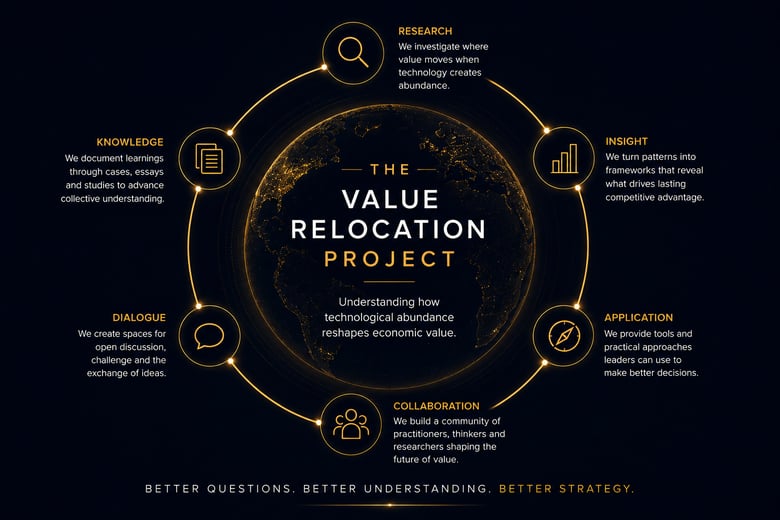
We examine how technology changes costs, access, scarcity and competitive advantage—not merely what the technology can demonstrate.
The framework is tested against historical transformations, current company cases and emerging market evidence.
The work should help leaders make better choices about strategy, investment, organizational design and innovation.
Complex transformation should be made understandable without being oversimplified.
Value Relocation is treated as an evolving field of inquiry. Cases, criticism and alternative interpretations are part of the project.
The Value Relocation Project was initiated by Roger Meili, an entrepreneur and business strategist with decades of experience at the intersection of technology, customer strategy and organizational transformation.
His work with companies navigating digital change led to a recurring observation: organizations often focus intensely on adopting new technologies while paying far less attention to how those technologies alter the underlying economics of their business.
The project grew from the attempt to formulate a clearer strategic question—not merely what artificial intelligence can do, but where value moves once intelligence becomes abundant.
Today, the project brings together a developing framework, a growing body of company cases, practical tools and contributions from leaders, entrepreneurs, investors and researchers.
“I did not start this project because the world needed another theory about AI. I started it because leaders need a better way to understand what AI changes economically.”
— Roger Meili
Profile
A clear model for understanding how technological abundance transforms competitive advantage.
Structured analyses of companies, industries and markets through the Value Relocation lens.
Short and long-form thinking on emerging scarcities, strategic consequences and new sources of value.
Thematic and industry-specific studies examining how value is being redistributed.
Practical methods that help organizations examine their own sources of scarcity and future advantage.
A concise introduction to the central idea and its implications for leaders, entrepreneurs and investors.
Conversations with people who are actively shaping or experiencing the relocation of value.
Value Relocation is not intended as a closed system. It becomes more useful when it is tested against different industries, business models and perspectives.
Take action - you have different possibilites to contribute!
Have you observed a market in which an established source of value is becoming abundant? Submit the case for possible inclusion in the Case Library.
CTA: Submit a Case
Constructive criticism, counterexamples and alternative interpretations are welcome.
CTA: Share Your Perspective
Researchers, executives, investors and specialists can contribute essays, interviews or industry insights.
CTA: Propose a Contribution
Organizations can explore Value Relocation through leadership discussions, workshops and strategic assessments.
CTA: Explore Collaboration
Join the project to receive new cases, essays, tools and publication updates.
Join leaders, entrepreneurs and investors examining how technological abundance is reshaping competitive advantage.
Receive new essays, company cases, framework developments and selected project updates.