

Where is value moving in your industry?
Join leaders, entrepreneurs and investors examining how technological abundance is reshaping competitive advantage.
Receive new essays, company cases, framework developments and selected project updates.
Every organization depends on assets, capabilities and relationships that are difficult for others to access, reproduce or replace.
Together, these sources of differentiation form its Scarcity Portfolio.
As artificial intelligence makes knowledge, analysis, content and code more abundant, leadership teams must understand which parts of their portfolio are losing scarcity—and which assets are becoming more valuable.
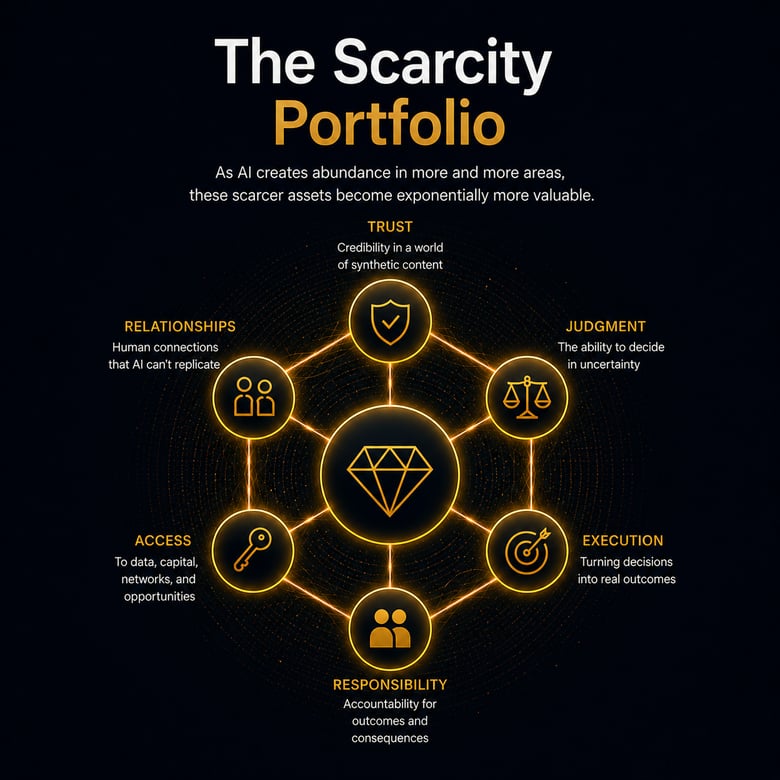
Most companies actively manage a product portfolio, a customer portfolio and an investment portfolio. Far fewer manage the underlying scarcities that make those portfolios valuable.
A product may generate revenue today because it contains expertise, access, trust, proprietary information, operational capability or customer relationships that competitors cannot easily reproduce.
If technology reduces that scarcity, the product can remain useful while losing its ability to command premium margins. The Scarcity Portfolio makes these hidden foundations visible.
A company does not lose its advantage only when its product becomes obsolete.
It loses advantage when the scarcity beneath the product disappears.
A Scarcity Portfolio is the collection of assets, capabilities, relationships, rights and constraints that enable an organization to create and capture value because they are difficult for others to access, reproduce or replace.
It answers three questions:
What makes us valuable today?
How durable is that scarcity?
What should we build for tomorrow?
A Scarcity Portfolio is not fixed.
Technology, regulation, customer behavior and market structure continuously alter what is difficult, available and valuable. The portfolio must therefore be reviewed and rebalanced over time.
A business may continue growing while its underlying differentiation is already being commoditized.
Strong current performance does not guarantee durable future value.
AI can make previously valuable capabilities widely available without immediately changing customer demand.
The visible market may remain stable while its economic foundations are shifting.
Trust, access, relationships, reputation, judgment and implementation capability may create substantial value without being formally recognized as assets.
Organizations tend to allocate capital toward the capabilities that made them successful.
The Scarcity Portfolio asks whether those capabilities will remain scarce.
As AI reduces the cost of producing convincing content, claims, identities and recommendations, it becomes harder to distinguish credible information from synthetic imitation.
The ability to be believed may therefore become more valuable than the ability to produce more information.
Why should customers believe us?
How long did that credibility take to build?
Could a competitor reproduce it quickly?
What could destroy it?
Judgment is the ability to interpret context, weigh incomplete or conflicting evidence and take responsibility for a decision when no objectively correct answer exists.
AI can generate options, forecasts and recommendations at scale.
But abundant recommendations do not eliminate ambiguity. They may increase it.
The scarce capability becomes the ability to determine which recommendation matters, when it applies and what trade-offs are acceptable.
Where does our business depend on decisions that cannot be reduced to a rule?
Who is trusted to make those decisions?
What experience or context makes their judgment distinctive?
Execution is the organizational ability to transform ideas, decisions and plans into reliable real-world results.
As ideas, plans, code and strategic recommendations become easier to generate, the bottleneck shifts toward implementation.
Value moves from knowing what could be done to being able to make it happen consistently.
What can we reliably deliver that others can only recommend?
Where do projects typically fail between insight and outcome?
Which execution capabilities are difficult to scale?
Relationships are durable connections between people and institutions that create trust, loyalty, information flow, cooperation and preferential access.
AI can increase the volume of communication but not automatically the depth of connection.
As outreach and content become easier to automate, authentic relationships may become more distinctive and more difficult to establish.
Which relationships provide access that cannot simply be purchased?
Are those relationships institutional or dependent on individuals?
How resilient are they when people leave?
Access is the ability to reach or use resources, markets, customers, data, capital, infrastructure, talent or opportunities that are not equally available to everyone.
When intelligence becomes widely available, many organizations can identify the same opportunities.
Advantage shifts toward those who can act on them because they control the necessary access.
What do we have access to that competitors do not?
Is that access owned, contracted or merely assumed?
Could technology, regulation or platform change remove it?
Responsibility is the willingness and capacity to stand behind a decision, product or outcome and accept its legal, financial, operational or ethical consequences.
AI can produce recommendations and actions, but accountability usually remains with a person or institution.
In high-risk environments, customers may place increasing value on organizations that are willing and able to guarantee outcomes, manage risk and remain answerable when something goes wrong.
Who is accountable when the recommendation is wrong?
Can we accept responsibility that others avoid?
Is our risk-bearing capability a source of value?
Different industries may depend on different forms of scarcity.
In some markets, physical infrastructure may matter more than relationships. In others, regulatory approval, cultural legitimacy, local presence, energy, talent or time may become the decisive constraint.
The purpose of the Scarcity Portfolio is not to force every business into six categories. It is to make the underlying sources of value explicit and test their durability.
The relevant scarcity is always contextual.
A two-axis matrix provides an ideal way of visualising our strategic positions.
The first axis describes our current strengths
The second axis describes future scarcities
High current strength / High future scarcity
Assets that are already strong and are likely to become more valuable.
These should be protected, reinforced and scaled.
Examples:
Low current strength / High future scarcity
Future-critical assets that the organization does not yet possess strongly enough.
These require deliberate investment, partnership or acquisition.
Examples:
High current strength / Low future scarcity
Assets that remain commercially useful but are becoming easier to replicate.
Organizations should monetize them while reducing future dependence.
Examples:
Low current strength / Low future scarcity
Capabilities that are neither distinctive today nor likely to become strategically important.
These should be automated, outsourced, standardized or discontinued.
A strong portfolio is not one with the most assets.
It is one aligned with future scarcity.
Each asset could be rated on a scale of 1 to 5.
1. Scarcity
How limited is the asset in the market today?
2. Relevance
How strongly does it influence customer value, revenue or competitive advantage?
3. Defensibility
How difficult is it for competitors to reproduce, acquire or bypass?
4. Durability
How likely is the scarcity to remain meaningful over the next three to five years?
5. Control
To what extent does the organization actually own or govern the asset?
6. Scalability
Can the asset support growth without losing its scarcity or quality?
01 — False scarcity
The organization believes an asset is difficult to reproduce, but customers or competitors no longer perceive it that way.
02 — Borrowed scarcity
The company depends on access controlled by a platform, partner, supplier or individual.
03 — Temporary scarcity
High value is created by a short-term bottleneck that technology, investment or regulation will eventually remove.
04 — Unscalable scarcity
The asset is genuinely rare but cannot support growth without being diluted.
05 — Concentrated scarcity
A critical relationship, judgment capability or network depends on one person or a very small group.
06 — Unmonetized scarcity
The organization possesses a rare and valuable asset but has not built an offer or business model around it.
07 — Legacy scarcity
The asset created competitive advantage in the past but no longer influences customer choice or willingness to pay.
Scarcity creates potential.
The business model determines who captures it.
Possessing a scarce asset does not automatically create economic value.
The organization must connect the asset to a relevant customer problem, build an offer around it and create a mechanism for capturing value.
Is the asset relevant?
Does it solve a problem customers care about?
Is the asset visible?
Do customers understand why it matters?
Is the asset embedded?
Is it integrated into the product, service or customer experience?
Is the asset monetized?
Does the pricing and business model capture part of the value created?
Trust may be strategically valuable, but it becomes economically meaningful only when it reduces perceived risk, increases conversion, supports premium pricing or strengthens retention.
Step 1 — Identify
Make the organization’s current sources of scarcity explicit.
Step 2 — Challenge
Test whether customers, competitors and technology still support those assumptions.
Step 3 — Anticipate
Identify which scarcities are eroding and which are emerging.
Step 4 — Rebalance
Shift investment from declining scarcity toward future-critical assets.
Step 5 — Embed
Connect scarce assets to offers, operating models, pricing and customer experience.
Step 6 — Monitor
Track changes in technology, regulation, customer expectations and competitive behavior.
Join leaders, entrepreneurs and investors examining how technological abundance is reshaping competitive advantage.
Receive new essays, company cases, framework developments and selected project updates.